


News | June 5, 2026
By Stan Folly, DevOps Talent Recruiter at Gologic.
The DevOps market is moving fast. And when you’re immersed in it every day, whether as a recruiter or as a professional, it’s hard to know exactly where you stand.
To get a clearer picture, we decided to ask the community directly.
For the second consecutive year, we surveyed DevOps professionals across Quebec. This time, 202 people responded. Not a census, but enough to identify solid trends that can’t be found anywhere else at the provincial level.
A few ground rules before diving in:
- We speak in medians, not averages (a single extreme salary can skew everything).
- We don’t present a trend when a group has fewer than 10 responses.
- And above all: correlation is not causation. We kept this distinction throughout the analysis.
Respondent profile: who works in DevOps in Quebec?
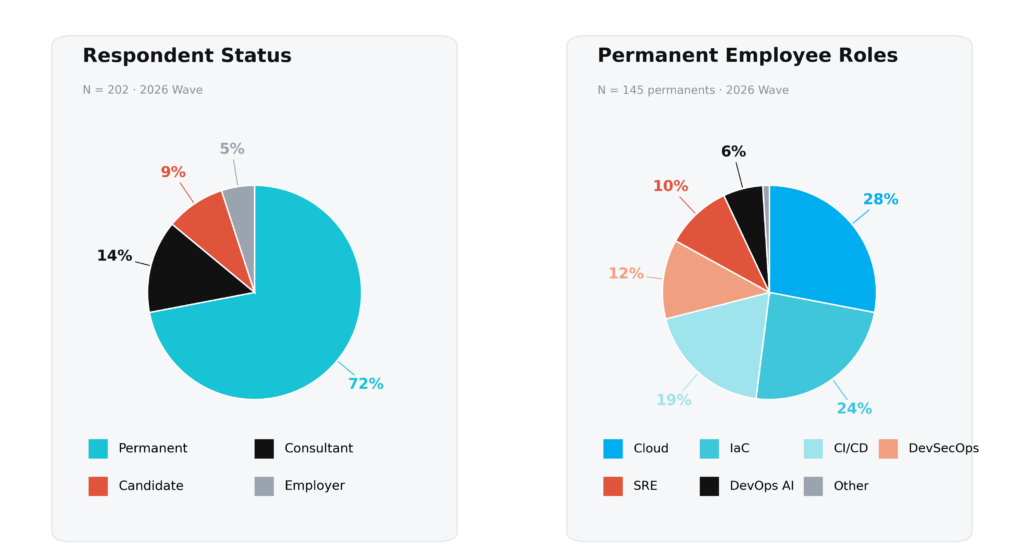
The typical profile is mostly permanent employees (72%), with a solid presence of consultants (14%). By role, cloud and Infrastructure as Code (IaC) alone account for half of permanent respondents. CI/CD follows at 19%, DevSecOps at 12%, and SRE (Site Reliability Engineering) at 10%.
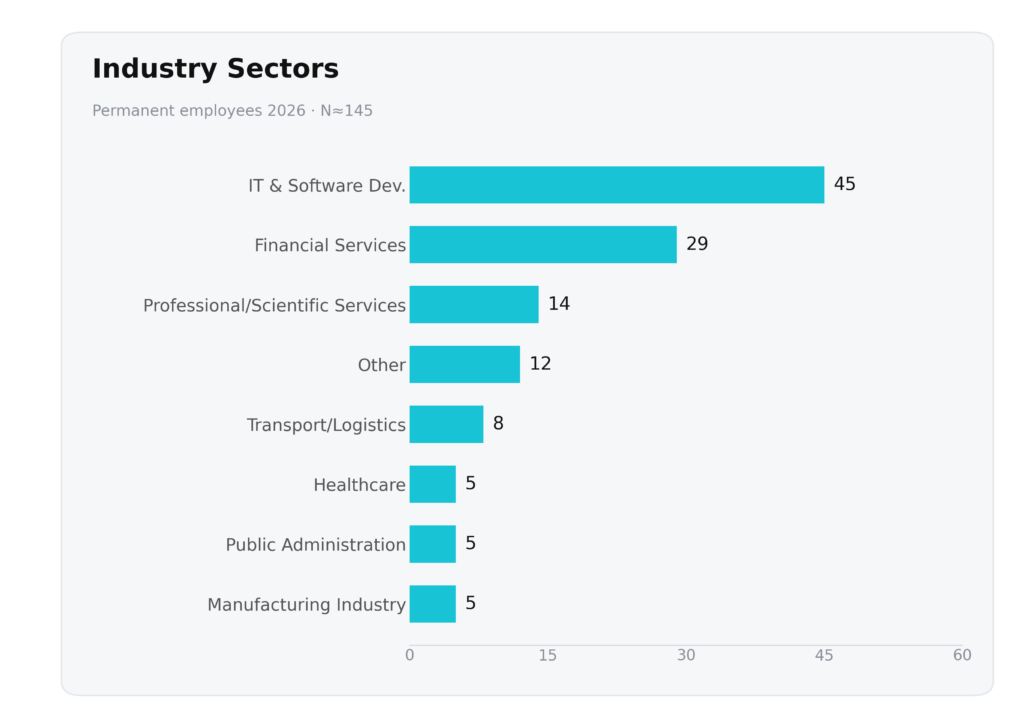
By sector, IT and software development (45%) and financial services (29%) dominate. DevOps in Quebec remains concentrated in these two industries.
DevOps salaries in 2026: the three factors that actually make a difference
We won’t be publishing precise salary grids; the sample size per subgroup doesn’t allow for the rigor we hold ourselves to. But three trends emerge:
1. The 6-8 year experience threshold
This is the strongest signal in the survey. We observe a +12% delta between the 0-5 year and 6-8 year experience profiles, consistently across cloud roles (18 respondents with 0-5 years, 9 with 6-8 years) and IaC (14 and 9 respectively).
This isn’t just a number. It’s the moment the market recognizes systemic expertise. You’re no longer the person who applies the technique, you’re the one who designs the architecture and makes platform-level decisions. The Quebec market validates this transition between years 6 and 8, and it shows up in job postings as much as in salaries.
If you have between 4 and 5 years of experience in cloud or IaC and are wondering when your salary will increase significantly, the answer is probably within the next 2-3 years, provided you take on design responsibilities, not just execution.
2. SRE and DevSecOps specialization
SRE and DevSecOps profiles are concentrated in the highest salary brackets. We can’t quantify the exact premium, but the survey points clearly to this trend.
The contrast with IaC is stark. A few years ago, mastering Terraform or Ansible was a rare skill. In 2026, it’s become the baseline skill every DevOps profile is expected to have. IaC alone no longer sets you apart. Security and reliability do.
A notable finding: there are no junior profiles (0-2 years) in SRE vs. DevOps or DevSecOps in our sample. The market doesn’t hire for these roles at entry level. It’s a career destination, not an entry point. If you’re starting out in DevOps, cloud and IaC remain your main doors in.
3. Company size
We observe a +7% to +9% delta in favor of large organizations (500+ employees) for cloud and IaC roles. This is consistent, but needs nuance: this delta also captures a composition bias. Senior profiles naturally gravitate toward large companies, which inflates that group’s median.
Company size is a factor, not the factor. Switching organizations purely for salary, without considering the type of projects and the level of autonomy, is probably not a sound strategic career move.
Remote work and DevOps in 2026: what the data reveals by sector
The office-versus-home debate seems to have stabilized. The 2026 figures show no major shift compared to 2025. Flexibility has become the norm, not an ongoing trend. But the data shows the answer depends on where people work and the size of the organization.
By sector
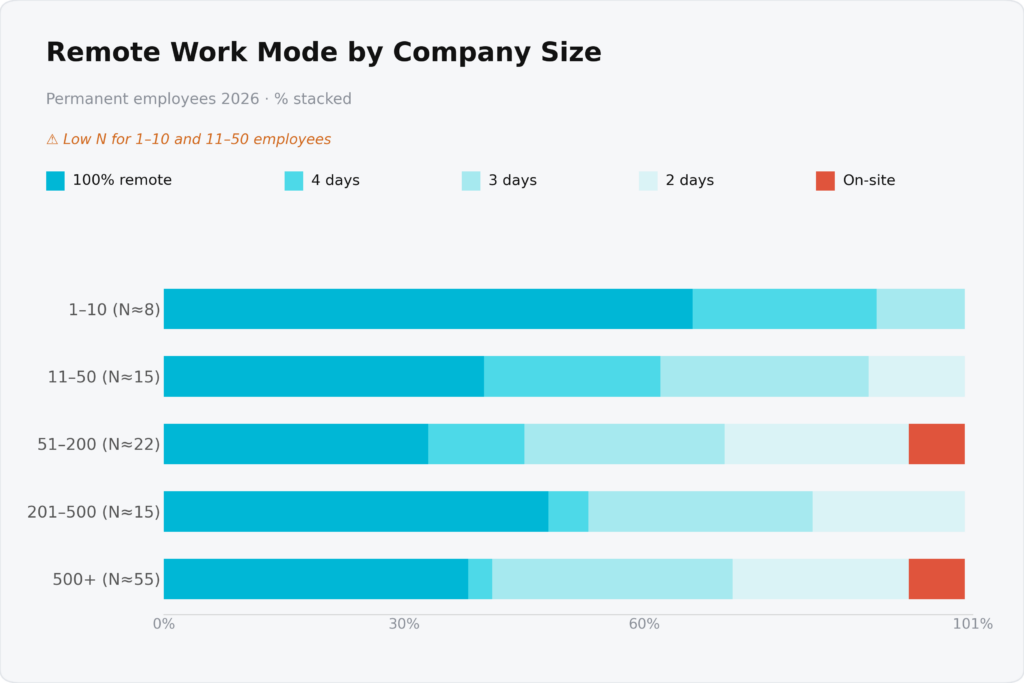
IT and software development show approximately 49% fully remote. Financial services follow at approximately 41%. Fully on-site has become quite rare, under 5% overall. Organizations recruiting DevOps talent today that don’t offer flexibility are not competitive in the hiring market. Flexibility has become the standard.

By company size
The larger the company, the more the 3-day hybrid model dominates (approximately 27% for 500+ employees). Smaller organizations (1-50 employees) compete with the higher pay rates of larger organizations by offering more flexibility through fully remote work.
By role
There’s no causal link between role and likelihood of working remotely. Among roles with a reasonable sample size: cloud (44% fully remote), SRE (43%), IaC (40%), CI/CD (36%). The gap exists but remains modest. How DevOps professionals work depends more on industry sector and organization size than on the role itself.
DevOps certifications: at what point do they actually pay off?
Do DevOps certifications increase salary?
Yes, but not from the first one. The gross differential is $27,500 between profiles with no DevOps certification training (median at $108K) and those with 6 or more (median at $135K). The real jump begins at 3 certifications, and accelerates from there.
But it’s the shape of the curve that’s interesting.
Going from 0 to 1 or 2 certifications moves the needle very little, staying around $112K. It’s a plateau. The real jump happens starting at 3 certifications, and accelerates beyond 6. In other words, that first AWS or Kubernetes certification doesn’t have a major impact on salary. But a portfolio of 3-4 certifications spanning multiple domains (cloud + security + orchestration, for example) starts to carry real weight.
Important note: it’s often the most senior profiles who accumulate certifications over the years. We can’t say “get 6 certifications and earn $27K more.”
But the signal is there. Certifications remain a marker of skill and value in the market, whether as a direct cause or as an indicator correlated with experience.

What DevOps recruiters are looking for in 2026
We surveyed employers separately. The sample is small (N=10), so we remain cautious, these are indicative trends, not a consensus.
The 4 non-negotiable technical skills for DevOps recruiters in 2026:
- Deployment automation — 90%
- Security — 80%
- Container management — 70%
- Observability — 70%
AI comes in at 40%. Not yet a requirement, but the direction is clear. We’ll be watching this closely for the 2027 edition.
On selection criteria, technical skills remain the number one filter (90%), but personality and experience tie at 70%. DevOps culture follows at 60%.
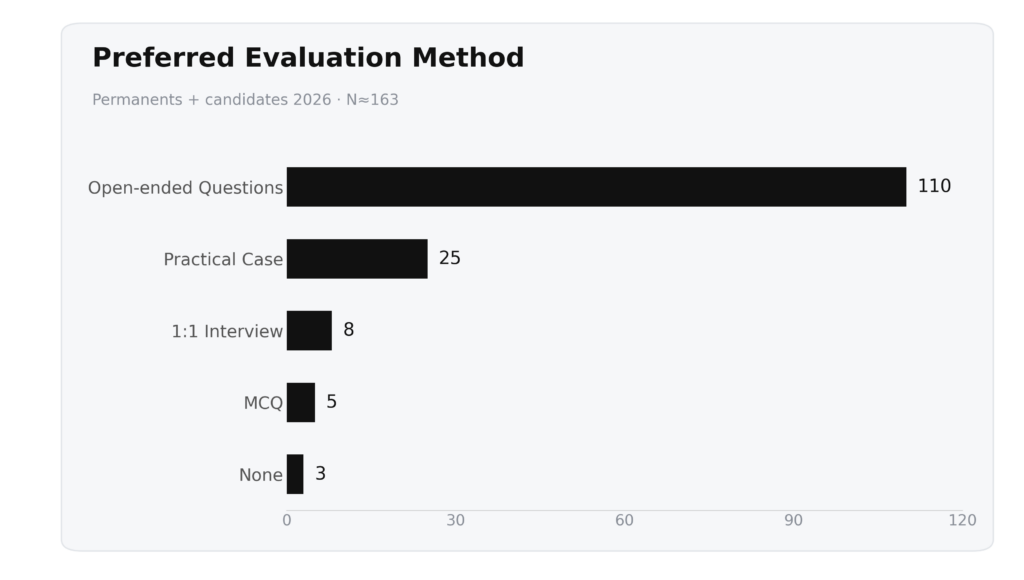
And for interviews? DevOps professionals overwhelmingly prefer open-ended questions (110 mentions) over practical case studies (25). Multiple choice and formal 1:1 interviews trail far behind. The message is clear: these professionals want to talk about problems they’ve actually solved, not perform an artificial coding exercise.

This is a signal for employers building their hiring process. A technical interview based on open-ended questions (“walk me through how you managed your last cloud migration” or “how did you structure your CI/CD pipeline“) will work better than a timed technical exercise, both for assessing real competence and for delivering a good candidate experience.
DevOps market 2025-2026: evolution or stabilization?
Compared with our 2025 DevOps market study, there’s no dramatic shift. The Quebec DevOps market continues its steady maturation. Here are the four signals that emerge from the comparison:
- Salaries slightly up. The overall median rises modestly, driven mainly by SRE and DevSecOps profiles, not by the market as a whole.
- IaC becomes commonplace. In 2025, mastering Terraform or Ansible was still a differentiator. In 2026, it’s the expected baseline. Value has shifted toward security and reliability.
- Remote work stabilizes. No massive return to the office, but the 3-day hybrid model has taken hold in larger organizations. The movement observed in 2025 seems to have reached equilibrium.
- AI enters the radar. Absent from recruiter criteria in 2025, it appears at 40% this year. Not yet a requirement, but the trajectory is clear.
What we’ll be watching in 2027: AI adoption within DevOps teams (40% this year, how much next year?), whether the SRE market eventually opens up to less senior profiles, and how fully remote work evolves now that the hybrid model appears to have stabilized.
Key takeaways: DevOps in Quebec in 2026
202 people, not 2,000. These are field trends, not absolute certainties. But when the signals point in the same direction across multiple roles and multiple groups, it’s worth paying attention.
We’ll run this exercise again next year. The more people who respond, the sharper the analysis will be. If you’d like to take part in the 2027 survey and get early access to the results, subscribe to our newsletter DevOps ta carrière!
Data collected between January and March 2026 from 202 DevOps professionals in Quebec. Analysis conducted by Gologic.